
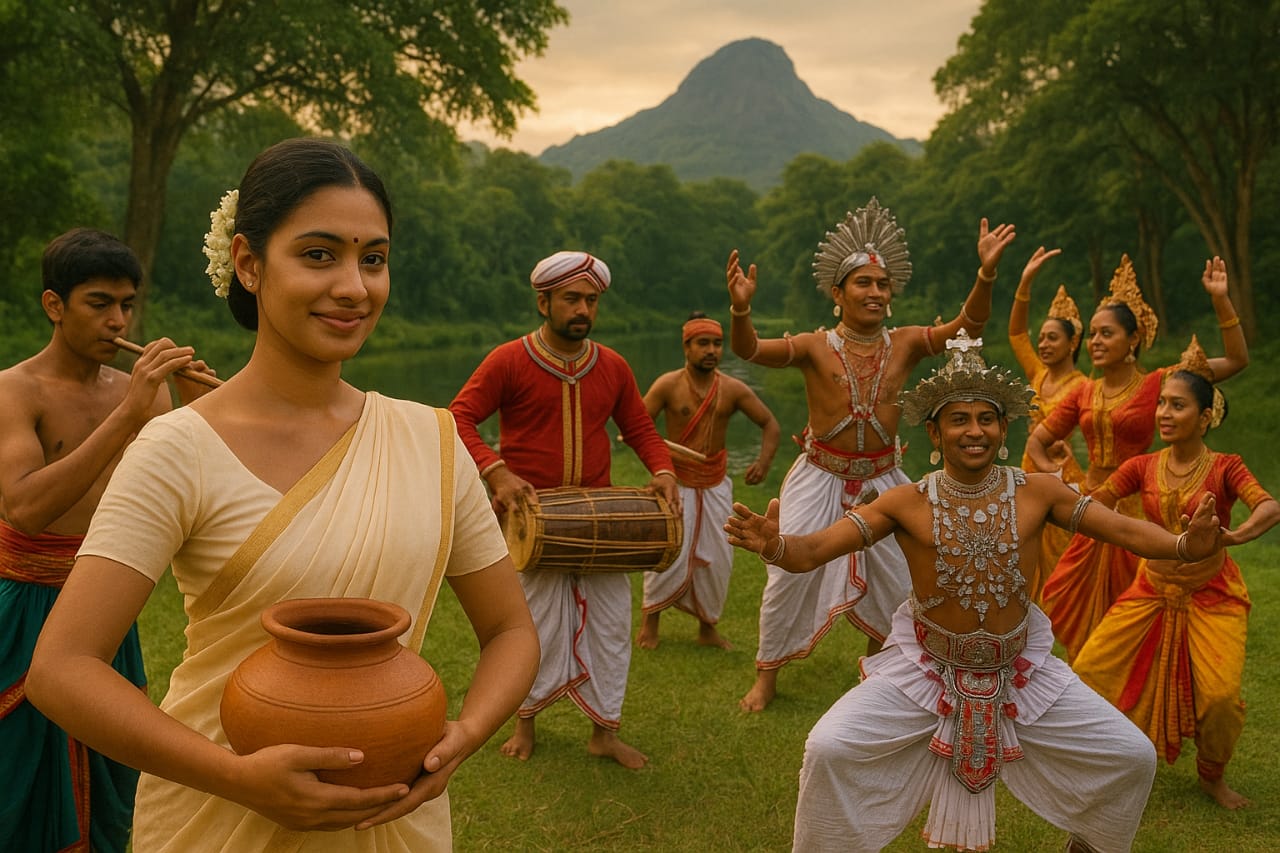

The traditional Sri Lankan greeting is “Ayubowan”(අයුබෝවන්), which translates to “May you live long” in Sinhala. It is often accompanied by placing both palms together in a prayer-like gesture and a slight bow. A more fortuitous greeting in urban areas is “Hello”, and in Tamil-speaking regions, “Wanakkam” is used.
The main languages spoken in Sri Lanka are Sinhala and Tamil. Sinhala languages is mostly spoken by the Sinhalese people. English is broadly spoken and used for education, business, and tourism.Ancient texts like the Mahavamsa (Great Chronicle) are key to Sri Lanka’s recorded history.
It was on the Day of Vesak two and a half millennia ago, in the year 623 B.C., that the Buddha was born. It was also on the Day of Vesak that the Buddha attained knowledge, and it was on the Day of Vesak that the Buddha in his eightieth year passed away.That day Free food or drink stalls organized by a community, company, institution and providing refreshments to the passers.

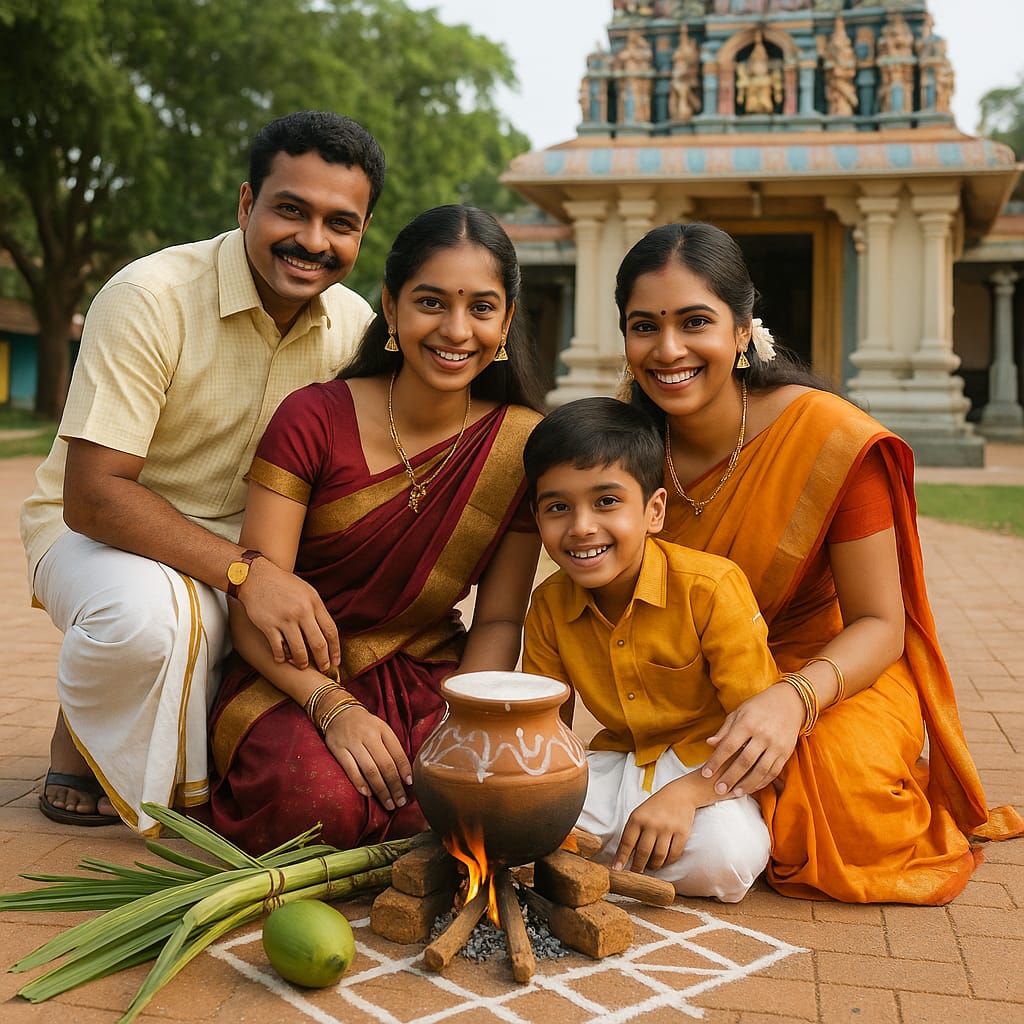
Pongal is a gather festival celebrated by the Tamil association.It is a celebration to thank the Sun, Mother Nature and the varied farm animals that help to contribute to a bountiful reap.There is much excitement and arrangement. New clothes are made or bought. The homes and yards are cleaned days ahead. Tasty aromas of Palakaram (sweet snacks) fill the air for days ahead.
Eid Mubarak! It’s a traditional Muslim greeting used to celebrate both Eid al-Fitr and Eid al-Adha, signifying “Blessed Feast” or “Happy Holiday”. It’s a way to express well wishes and blessings during these festive moments.

Christmas, celebrated on December 25th, is a Christian festival memorializing the birth of Jesus Christ.It’s a time for religious adherence, family gatherings. gift-giving, and festivel adornments. In Sri Lanka, Christmas is a widely celebrated holiday, pay attention by Christians and embraced by many non-Christians as well.

Throughout history, Buddhism has played an important role in influencing the various arts and crafts of Sri Lanka. These include intricate wood carvings, vibrant batik textiles, handwoven fabrics, pottery, lacework, and jewelry making.

Buddhist paintings in Sri Lanka fall into two main categories: the classical and the Kandyan. The classical period can be identified from the fifth to the thirteenth century which includes both the Anuradhapura and Polonnaruwa eras.The Kandyan period last from the eighteenth to the nineteenth century.
Traditional painting refers to the age-old art form that utilizes techniques and materials passed down through generations, including oils, watercolors, and acrylics.This procedure emphasizes manual skills, enabling artists to convey emotions and tell stories on canvas.
The art of Sri Lankan sculpting is blessed with a long and illustrious history. From Buddha statues, Bodhisattva statues and various religious statuettes to various adornments used for religious architecture, the art of sculpting in Sri Lanka boasts of a plethora of different creations.The three main types of sculptures include assembly, carving, and modeling.

The traditional Sri Lankan mask is hand carved by an ‘edura’, or an exorcist, using raw materials grown comparably in Sri Lanka.The bark of a tree is stripped, and the trunk is then divided into workable pieces. This is then whittled down, carved and then smoothed using different leaves.


Sri Lanka has a historical connection to handlooms and the loom had been portrayed bountifully in local myths and legends. With records of Sri Lanka trading vividly designed cotton textiles with India and China as far as 1000 years ago, the country has been known as a hotspot of textile production.
Sri Lankan traditional handloom is a centuries-old craft profoundly rooted in the island’s cultural heritage. It involves complex weaving techniques passed down through generations, resulting in spirited textiles that reflect the creativity and artistry of Sri Lankan weavers.

The Batik industry in Sri Lanka is a small sector of the Sri Lankan textile industry. During the latter half of the 20th century, the Indonesian of batik -making became firmly instituted in Sri Lanka.
The technique was brought to Dutch Ceylon at the turn of the 19th century.It serves as a high-value export within the textile industry, and it is now a highly visible craft with galleries and factories, large and small, having emerged up in many tourist areas.
Sri Lanka has a rich history of jewelry making, deeply entwined with its gem and mining industry. Traditional jewelry styles, like the Kandyan and Galle traditions, are still practiced, displaying intricate metalwork and precious stones. Modern designs, often incorporating silver and semi-precious stones, are also popular, particularly for export.

ceramics of Sri Lanka is one of the traditional small industries. stoneware’s are perhaps the most widespread of all art forms to have emerged from human history.The relationship between hands and clay is the basis of the ceramic art form.

The Sri Lankan education system is structured in three main stages: primary, secondary, and tertiary. It is free and mandatory for children aged 5 to 14. The system includes both government and private schools, with the Ministry of Education overseeing both.
Includes universities and other higher education institutions. Students need to pass the GCE A/L exams to be qualified for university admission. Offers a variety of programs, from certificates to doctoral degrees.
Volleyball, officially known as the national sport of Sri Lanka in 1991, has a rich history that dates back to its introduction in the country in 1916. Since then, it has become a symbol of unity, teamwork, and resilience, celebrated by players and fans throughout the island.
Cricket is incontestably the most popular sport in Sri Lanka, with a fan base that spans generations.The national cricket team has fulfilled global recognition, winning the ICC Cricket World Cup in 1996 and producing legends like Muttiah Muralitharan and Kumar Sangakkara.


Saree is a purely women’s clothing. The traditional Kandyan saree (osaria) is the popular costume in Sri Lanka and is worn by women for all ranges of events. Some wear a saree on a daily basis, or because their work uniform calls for a saree. School teachers and office women wear sarees, as well as tea puckers when it is their custom. In official events and celebrations, traditional clothing is a saree that must be very colorful, bright and decorate.
This dress is worn by Sri Lankan women in many different styles. There are two ways of draping the saree: the Indian and the Kandyan style. The Kandyan one is more popular in the hill region in Kandy from which the style originated. It comprises of a full blouse that is 6 – 8 meters in length and covers totally the midsection and is partially tucked at the front. The top is a scarf or a piece of cloth put on the shoulder of the women and tucked in the skirt.


In many regions, men combine a sarong with a long-sleeved shirt. There are quite a few ways for men to wear a sarong. They sometimes tie it and make a knot in front, or they wrap around like a skirt, while others put the end between the legs and tie or tuck into the sarong. Sometimes they’re at home, they leave the upper body parts open or wrapped up in a divide piece of cloth such as a wide scarf.

A Tamil Hindu wedding is a vibrant celebration of union, rich in tradition and allegory. It typically involves a series of pre-wedding ceremonies, the main wedding ceremony, and post-wedding rituals, all designed to bring two families and two individuals together in a sacred bond.
The Tamil wedding tradition says that the Groom should present a saree as a grist to his Bride. It is a symbol of acknowledgment into the Groom’s family.A saree is usually a traditional red silk dress with elegant gold thread embroidery and beadwork. The bridal saree and a Thali necklace (also presented by the Groom) are passed to the wedding guests for their blessings.
The Bride leaves the alter for a moment to put on her sari and makes a second trip down the aisle, carrying a fresh floral garland for her Groom. (includes music, dancing, food, and cake cutting)

A Sinhala wedding, also known as a “Poruwa Ceremony”, is a mix of Buddhist traditions, astrological rituals, and cultural values. It focuses on family, blessings, and the sacred bond between the couple.
After rituals, the legal registration is done in front of family and guests. A witness from each side signs the document. includes music, dancing, food, and cake cutting. The couple greets all guests (called the “Going Round”) and takes photos

A Muslim wedding, known as a Nikah, is a religious ceremony where a Muslim couple legally marries under Islamic law.It’s a predictive tradition and the only acceptable way for a couple to be married in Islam. The Nikah ceremony typically involves the reading of the Quran, the exchange of vows, and the signing of a marriage contract in the presence of bystanders.

A Christian wedding is a ceremony where two people publicly declare their love and commitment to each other, often in a church, in front of God. It is a sacred rite of passage, a celebration of love, and a symbol of a lifelong responsibility rooted in faith.
The ceremony includes vows, ring exchange, and prayers, often with specific traditions depending on the denomination. Christians view marriage as a sacred covenant, a lifelong commitment between a husband and wife, reflecting Christ’s relationship with the Church.
Sri Lankan cuisine is a vibrant tapestry of flavors, heavily motivated by its geography and history. Rice and curry form the heart of the culinary experience, with a variety of curries made from vegetables, fish, or meat, often stewed in coconut milk and infused with spices like cinnamon, cardamom, and cloves. Beyond rice and curry, Sri Lanka offers a diverse range of traditional dishes, from street food favorites like kottu roti to sweet treats like watalappan.

Hearty and spicy. Common breakfast foods include:

Popular throughout the day and very affordable:

Often served during festivals, religious events, or with tea:

Traditional medicine in Sri Lanka includes our different systems: Ayurveda, Siddha, Unani and Deshiya Chikitsa. In Ayurveda, therapeutic agents for curing disease are mostly herbal preparations, while in the Siddha system they are something is mostly mineral preparations.
Although its main focus is on herbal medicines, the importance of Ayurveda encompasses additional techniques to improve your health and vitality, including nutrition, exercise, meditation, yoga, and detoxification methods.
Ayurveda, the ancient system of holistic healing, focuses on balancing the body, mind, and spirit to prevent and treat diseases. Common ailments like eczema, heart disease, arthritis, and indigestion are addressed by identifying the root causes, often linked to disproportion in the doshas. (Vata, Pitta, and Kapha).

Sri Lanka is a rich and green country. Sri Lanka is a beautiful island nation located in South Asia, just off the southeastern coast of India. Known as the “Pearl of the Indian Ocean,” it is famous for its rich history, diverse culture, and breathtaking natural beauty.The country has a long history that dates back over 2,500 years, with influences from Buddhism, Hinduism, Portuguese, Dutch, and British colonial rule. Its capital city is Sri Jayawardenepura Kotte (administrative), while Colombo is the commercial center.
Sri Lanka’s population is made up of different ethnic groups, mainly Sinhalese, Tamils, Moors, and Burghers. Sinhala and Tamil are the official languages, an d Buddhism is the major religion, followed by Hinduism, Islam, and Christianity.